


Blog
Choosing the Right LNG Event to Secure Budgets for Your Solutions
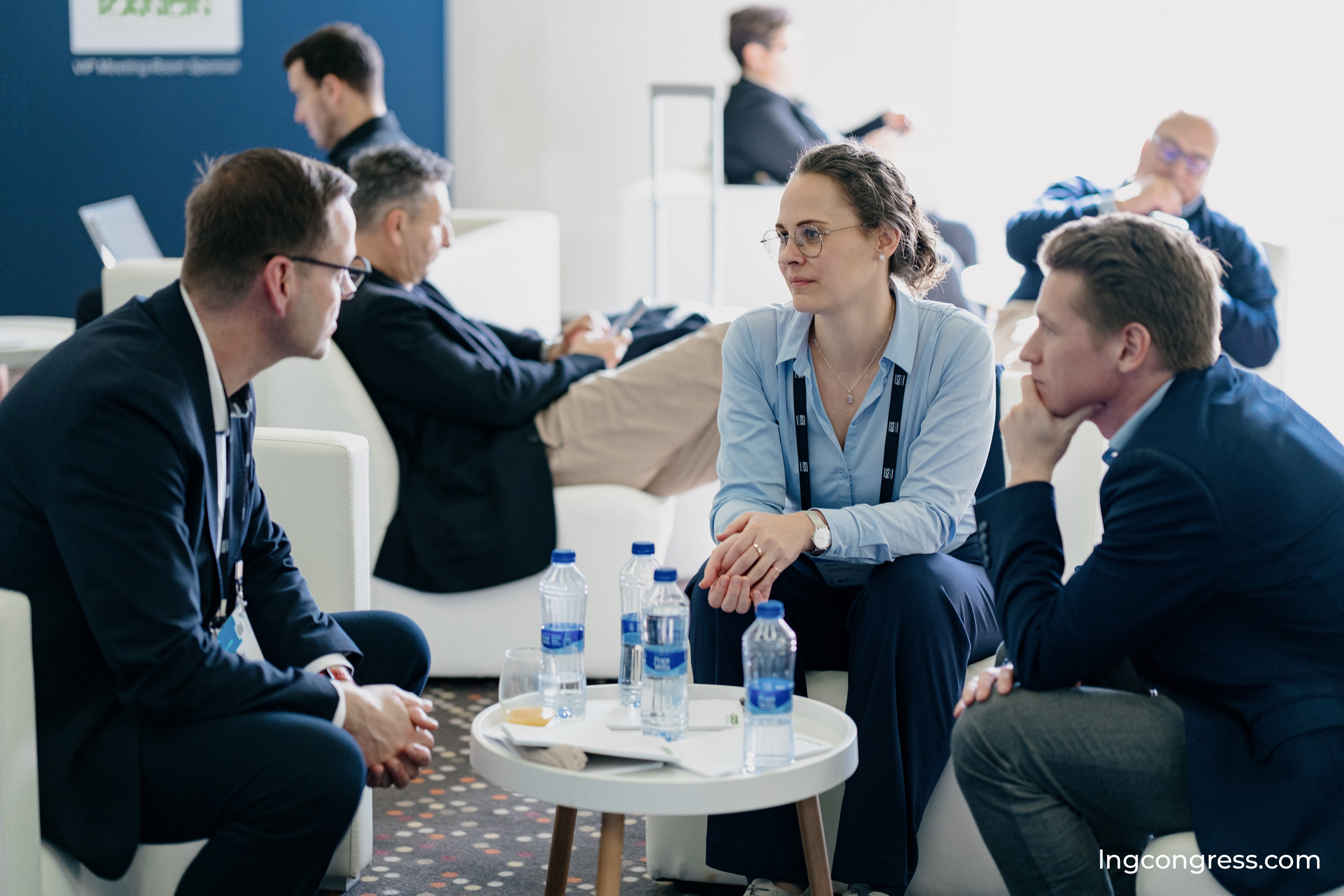
Every year, the LNG industry calendar fills with conferences, expos, and summits promising direct access to clients. Most of that access never converts. Industry-wide, a lead from a general trade-show booth sees roughly a 1.9% in-person conversion rate, compared to 13% from a pre-scheduled meeting, according to research by Vendelux and Converve.
If your goal is not just visibility but actual budget conversations, the event you choose matters more than how many people attend it.
The Problem With Reaching Decision-Makers From APAC and Europe
LNG demand and investment activity are increasingly concentrated in two regions: Asia-Pacific, where buyers are securing long-term supply and building import infrastructure, and Europe, where diversification away from pipeline gas has accelerated terminal and regasification projects. These are the markets where budget decisions are actually being made right now.
The challenge is that the people who control those budgets rarely attend large open-format expos in a way that makes them accessible. They send junior staff to walk the exhibition floor, while they themselves attend by invitation only, sit in private meeting rooms or skip the show altogether and rely on their teams for a summary afterward.
Although a big trade show provides mass exposure and increased brand awareness for your company, it rarely helps to secure a budget. More than 90% of senior marketers confirm that events deliver real value only when the room has the right seniority in it. This is where closed-door events make the real difference.
How Closed-Door Events Work Differently
Closed-door, invitation-only events are built around a different mechanic entirely. Instead of maximising the number of participants, they maximise the quality of decision-makers in the room.
A few structural reasons this format converts better into budget conversations:
1. Attendance is curated. Participants are invited based on their role, expertise and current project stage. This means the person across the table from you at a closed-door LNG event is holding real influence over the company’s strategy.
2. The environment favors depth over noise. Without thousands of attendees and a trade-show floor competing for attention, conversations run longer and get more technical faster. Decision-makers are more willing to discuss real project timelines, budget cycles, and pain points when crowds do not surround them.
3. You are not competing for clients. A closed-door format typically caps how many solution providers from the same segment attend the event.
What This Looks Like in Practice
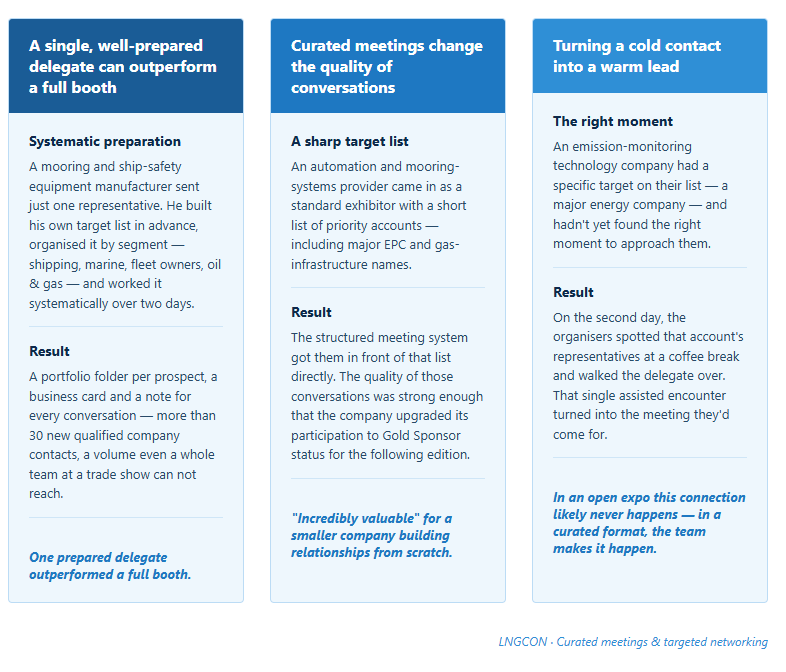
The case for closed-door formats shows up repeatedly in how solution providers actually use these events. We asked participants from the major LNG closed-door event - LNGCON - what they got from the closed-door format.
Build a Working Strategy Before the Doors Open
Even within a closed-door format, you need a working strategy and a clear read on where decision-makers' priorities currently sit. Our previous article looked at what solution categories decision-makers are actively budgeting for right now; this one is about who to find in the room and how to get there before the event starts.
Treat the guest list as a planner
Most vendors skim the delegate list the week before the event. Run it through your CRM: sort every name into one of three categories – an active opportunity, a cold outreach or an account you've never touched. Against each one, log where things stood last and write down what a realistic next move actually looks like given that history. The output should be a short, honest shortlist, something in the range of fifteen conversations, that would justify the cost of sending someone to the event, each with a specific reason you're initiating contact rather than a generic "good to connect."
The organisers are your go-to partners for quality meetings.
Don't stop at the list itself, either. Ask the organiser for context: how the operator-side mix compares with last year, which functional areas each represented company sent people from, and whether any of the accounts already on your target list are confirmed to attend. That's the difference between planning around a spreadsheet of names and planning around an actual map of the room.
Timing Matters as Much as Format
Q1 is a structurally strong window for going to an industry event. Most companies with a calendar-year fiscal start plan their annual budgets in Q3, finalise them by mid-December, and release funds to departments at the start of the new year. What follows is a Q1 execution window where spending velocity is highest, because the budget has just been approved and teams are moving on the projects it was allocated for. Industry research indicates that nearly 50% of all B2B purchases occur in the first six months of the year.
An event held in Q1 sits right inside that window, and choosing to attend during this period gets you more chances to secure a budget
Look past the corporate rank and evaluate the actual buying influence
At closed-door O&G events, a senior title only tells half the story. What really matters is understanding where that individual sits in the actual buying cycle. You have to look for who holds the budget, who's the one framing the problem internally, who has to validate the solution before it moves forward technically, and who has enough standing to speed the next step up. Map out the specific roles that drive these decisions: CEOs, Managing Directors, CFOs, COOs, Procurement Heads, CDOs, CTOs, and VPs of Upstream, Downstream, Operations or Strategy.
Where Conversions Convert: LNGCON 2027
Everything above describes the operating model behind LNGCON – a closed-door format designed to connect LNG solution providers with decision-makers from APAC and European buying organizations. Instead of an open exhibition floor, LNGCON structures its program around curated attendance, no-time-limit B2B meetings and a regional focus on the markets where LNG infrastructure investment is actually happening.
For solution providers, that translates into fewer but higher-quality conversations: meetings with people who have both the technical mandate and the budget authority to move a deal forward, in a setting designed for depth rather than volume.
Explore LNGCON 2027 business programme
Sources:
1. https://www.my-outreach.com/blog/marketing-through-the-summer-slump
3. https://financial-marketer.com/understanding-the-revenue-time-lag-in-b2b-marketing/
4. https://www.converve.com/event-networking-blog/how-to-run-hosted-buyer-programme-tourism-trade-shows