


Blog
Small-Scale LNG: Why the Next Wave of Growth Needs a Different Kind of Infrastructure

Shell’s 2026 Outlook warns that disruption in the Strait of Hormuz could produce flat or negative LNG trade growth this year, the first contraction in over a decade. Small-scale LNG is not following that curve: Singapore’s LNG bunkering rose 48% in Q1 2026, to 150,000 tonnes.
Demand is only half of that story. The other half sits in DNV’s September 2026 white paper, which warns that the LNG bunker vessel fleet may need to more than double by 2030 because demand from LNG-fuelled ships is outpacing the supply chain behind it. Small-to-mid-scale LNG (ssLNG) is growing faster than the infrastructure built to serve it.
This gap is the focus of “Small-Scale LNG: Building Flexible Energy Solutions” – a closed-door roundtable at LNGCON 2027. The discussion is held among those who own, finance or ship LNG in this segment.
Where ssLNG Wins: Economics, Speed and Optionality
The case for ssLNG is not just about filling the 10–150 MW demand band where pipeline NPV turns negative. The real advantage is capital velocity and optionality: extending a pipeline takes 5–7 years, while modular ssLNG deployment takes 18–24 months.
Majors are reallocating CAPEX to capture that speed-to-market in three zones:
-
Southeast Asia: Pertamina’s “virtual pipeline” monetises stranded gas without inter-island CAPEX traps, while Petronas expands bunkering at Tanjung Pelepas to capture marine and industrial offtake margins.
-
Sub-Saharan Africa: With mega-LNG export timelines slipping, Shell and TotalEnergies are deploying flexible ssLNG for mining hubs, replacing diesel and securing premium industrial margins.
-
Nordic & Arctic: Gasum and Equinor are heavily investing in pan-Nordic small-scale distribution networks and long-term bunkering agreements (including bioLNG supply for heavy-duty transport and inland depot terminals).
Industrial and Off-Grid Demand: The Most Resilient Offtake
While power attracts attention, the most resilient ssLNG demand comes from hard-to-abate industries: cement, glass, ceramics and heavy manufacturing. These sectors need high-grade process heat that electrification cannot yet provide cost-effectively.
Here ssLNG is a pragmatic, immediate bridge. Decentralised combined heat and power (CHP) plants fuelled by ssLNG are displacing coal and petcoke in industrial clusters. China alone has deployed over 200 small-scale LNG distribution stations serving ceramic and textile hubs, with reported particulate reductions above 95% and thermal-efficiency gains of 15–20% versus coal.
In off-grid micro-grids, ssLNG provides firm, dispatchable baseload that intermittent renewables cannot deliver on their own. That matters at remote mines and island communities, where diesel logistics are expensive and volatile.
From Pilot to Network: The Financing Gap
On paper, the economics work. In practice, bankability is the constraint. According to Wärtsilä’s analysis, the first of three key challenges for ssLNG expansion is the “high up-front capital cost of establishing a small-scale LNG supply chain”. Projects in the US$20–50 million range fall into the “missing middle” of project finance: too small to attract mega-infrastructure funds, yet too operationally complex for standard corporate debt.
Getting from a single pilot to a scalable network requires a different financing structure. Industry leaders are moving from single-asset project finance to portfolio-level financing. Companies such as Avenir LNG, for instance, aggregate a growing fleet of small-scale LNG bunkering and distribution vessels to secure larger, better-priced credit facilities — closing a USD 128 million package for two newbuilds in late 2025 and de-risking the portfolio through geographic and offtake diversification across its global customer base.
Delivery Risk: The Tightest Point in the Chain
The second constraint is delivery, and this is where the market is tightest. According to Clarksons Research and SEA-LNG data, the order book for LNG-fuelled vessels is expanding aggressively, while the dedicated small-scale bunker fleet and supporting supply chains struggle to keep pace. Delivery design is becoming a competitive variable, and Gerben Dijkstra (Head of Business Development, Anthony Veder) will address it at LNGCON 2027.
Satellite Terminals: What Works Today?
The most robust model is the satellite terminal fed by trucks or ISO containers, which delivers gas as if it came from a pipeline. A roughly 50 MW plant needs about 380 m³ of LNG storage (around 100,000 US gallons), a footprint small enough to standardise and copy from site to site. This model is already proven: Madeira has run on 64 ISO containers and a 600 m³ satellite plant since 2014.
Bio-LNG: Getting More from the Assets You Already Have
Bio-LNG is chemically the same molecule as fossil LNG, so satellite terminals, ISO containers and cryogenic trailers can handle it without large-scale rebuilds. Depending on feedstock and methodology, lifecycle CO₂ reduction can reach 80–90%. Demand is being pulled by RED III and FuelEU Maritime, and the transition is already under way: Rotterdam’s bio-LNG blend bunkering grew more than six-fold in 2025, with 15,260 cbm bunkered in Q1 2026 alone.
So the real retrofit question is not equipment. It is how to integrate renewable gas into existing networks and prove its origin through mass-balance accounting well enough to capture the regulatory premium. Frits van der Velde (Program Director Biomethane, Gasunie) will cover exactly that at LNGCON 2027.
Why This Conversation Needs a Closed Door at LNGCON 2027
Operators rarely publish CAPEX and OPEX per delivered MWh, the cost of a missed delivery or the terms of a supply-interruption clause from a main stage. Among colleagues, they do. That is why LNGCON 2027 puts this topic in a closed-door roundtable, and why Gasunie, Anthony Veder and decision makers across the value chain will be in the room.
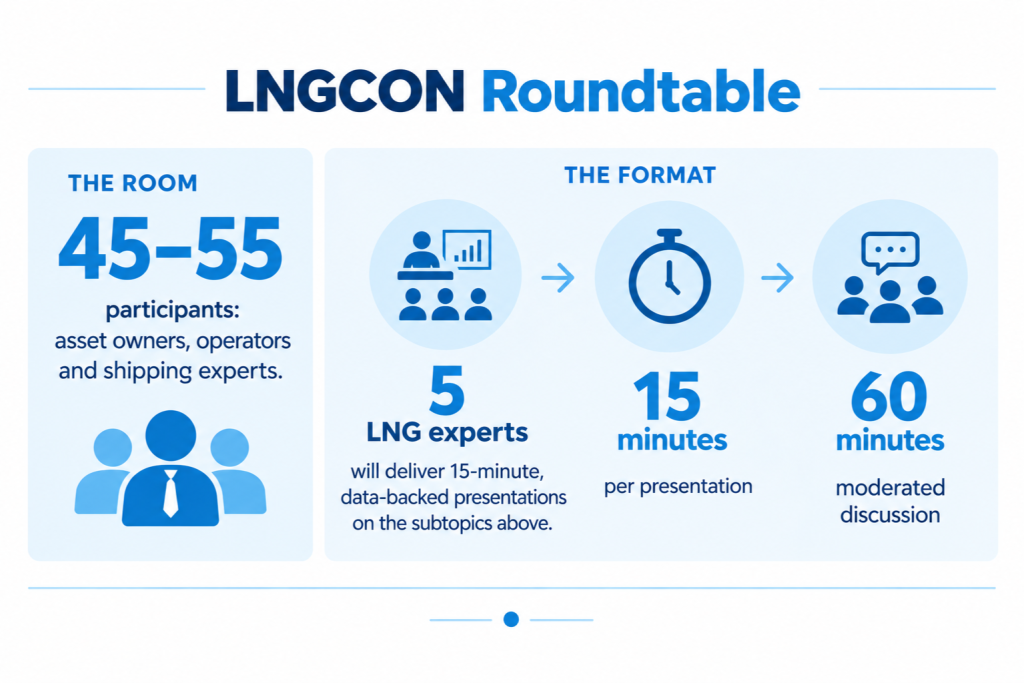
The format is built for exchange rather than presentation. 45–55 participants: asset owners, operators and shipping experts sit in one room. Five LNG experts each deliver a 15-minute, data-backed presentation on the topics above, followed by 60 minutes of moderated discussion: short inputs, long conversation, real numbers.
If you operate, finance, ship, supply or consume small-scale LNG and have real numbers to share (costs, failure cases, financing structures that worked or did not), submit a speaker application. If you would rather see the wider context first, request the full LNGCON 2027 programme.
→ Submit a speaker application → Request the full LNGCON 2027 programme
Sources:
-
scribd.com/document/846854049/Beating-the-gas-conundrum-in-Australia
-
https://ieefa.org/data-dive-drivers-barriers-and-costs-asias-gas-and-lng-demand
-
https://www.fortunebusinessinsights.com/small-scale-lng-market-117282
-
https://www.shell.com/what-we-do/oil-and-natural-gas/liquefied-natural-gas-lng/lng-outlook-2026.html
FAQ Section
1. What is LNGCON?
LNGCON (the International LNG Congress) is a closed-door networking event that brings together C-level executives, asset owners, operators and shipping experts across the entire LNG value chain. LNGCON 2027, taking place in Amsterdam, features dedicated sessions and high-level networking focused on the future of LNG markets, infrastructure development, and the global energy transition.
2. Who is the target audience for LNGCON 2027?
C-level executives and decision-makers across the LNG value chain: gas majors (Shell, TotalEnergies, bp), EPCs (Linde, Wood, GTT), terminal/port operators, shipping companies (EXMAR, Anthony Veder), industrial offtakers, and financiers focused on ssLNG and bio-LNG. Closed-door format for 400+ delegates, 60+ speakers.
3. What is the format and focus of the Small-Scale LNG Roundtable?
Titled "Small-Scale LNG: Building Flexible Energy Solutions," this roundtable focuses on the widening gap between rapid ssLNG demand and lagging infrastructure. The format is built for high-value exchange rather than standard presentations. It features five industry experts delivering 15-minute, data-backed presentations on key sub-topics (economics, satellite terminals, bio-LNG integration, and the financing gap), followed by 60 minutes of unfiltered, moderated peer discussion.
4. What leaders involved in ssLNG will be at the event?
Companies active in ssLNG confirmed at LNGCON 2027:
-
Anthony Veder — ssLNG shipping
-
Gasunie — bio-LNG integration
-
Nordsol — decentralized bio-LNG
-
EXMAR — modular LNG delivery
-
Shell — marine LNG & bio-LNG
-
Orlen — bio-LNG value chain
-
TotalEnergies — flexible ssLNG deployment
-
Gasum — Nordic small-scale distribution & bio-LNG bunkering
-
Avenir LNG — small-scale bunkering vessels & terminals