


Blog
The 2026 LNG APAC Boom - How Vendors Can Capture the Wave of Surging Demand
The vendor’s playbook is being rewritten as the 2026 LNG market now unfolds on the buyer's terms. Adding to that is Europe’s structural reliance on LNG and Asian gas demand that is projected to grow three times as quickly in 2026 as in 2025. This market shift presents vendors with new business opportunities. Yet converting that potential into contracts requires restructuring your go-to-market approach and understanding how these markets operate and what solutions companies are currently searching for.
The New Geography of Demand - APAC Region
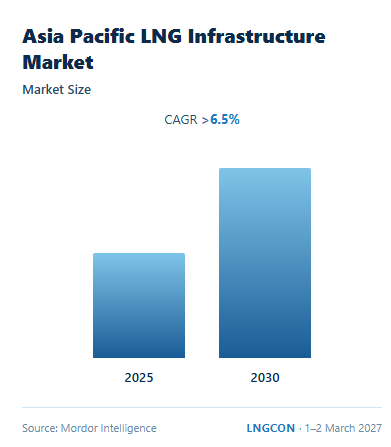
The demand curve has shifted decisively eastward. Asia-Pacific has become a primary engine of global LNG demand growth. Projections indicate Asian LNG demand will rise fr om roughly 270 bcm in 2024 to approximately 510 bcm by 2050, with Southeast Asia accounting for a substantial share. According to the Energy Information Administration (EIA), Asian countries, such as China, India, Bangladesh, Thailand, and Vietnam, are expected to consume 120 billion cubic feet per day (bcf/d) of natural gas by 2050, outpacing regional natural gas production by 50 bcf/d. The supply imbalance in the region is likely to result in increasing dependency on other regions, which is expected to create an opportunity for the market players in the forecast period, as these projects are paving the way for vendors to source their solutions.
Understanding APAC Markets
What makes APAC distinctive is how uneven its markets are. The operational, regulatory and commercial characteristics vary significantly:
1. China
China offers the largest volume opportunity, but it is not the easiest market for international vendors. The market is shaped by large state-linked players, significant domestic infrastructure and strong price sensitivity. Regulatory pricing and limited third-party access are constraining competition and market flexibility.
Vendor implication: China is a scale market, but winning usually requires localisation, strong domestic partnerships or a technology advantage that is difficult to replicate locally.
2. India
India's opportunity is driven by expanding LNG use, but the economics are highly price-sensitive and infrastructure connectivity remains critical. The gas market has historically combined regulated domestic gas pricing with more expensive imported LNG, while third-party access to pipelines and LNG infrastructure has been an important part of market reform.
Vendor implication: India is attractive for vendors that can demonstrate lower total cost as buyers pay close attention to CAPEX and OPEX.
3. Southeast Asia
Vietnam, the Philippines, Indonesia, Thailand and Singapore have very different market structures, but share one strategic problem: domestic gas supply is under pressure while energy demand continues to grow. HFW highlights declining domestic production, growing LNG import dependence and the development of new receiving infrastructure across the region.
Vendor implication: This creates the strongest opening for vendors because many projects are still developing their infrastructure, operating models and supply chains.
4. Japan & South Korea
Japan and South Korea should not be approached as volume-growth markets. They are sophisticated LNG ecosystems wh ere the opportunity is increasingly in performance, efficiency, flexibility and lifecycle optimisation.
Japan has extensive LNG receiving infrastructure and a long history of seeking greater flexibility, competition and transparency in gas procurement.
For maritime vendors, the technical bar is particularly high: Asian operators increasingly evaluate LNG fuel systems on integration, certification, redundancy, boil-off-gas management, fuel measurement, local service coverage and spare-parts availability, not just equipment price.
Vendor implication: these are high-value reference markets, but winning requires demonstrable performance and strong technical credentials rather than a broad sales proposition.
The European Dimension: A Parallel Demand Stream
While APAC dominates the long-term growth narrative, Europe remains a critical and structurally elevated demand centre that vendors still need to keep in mind.
The EU's LNG import capacity reached roughly 242 bcm per year in 2025, up 76 bcm since 2021, and a further 100 bcm is expected to come online between 2025 and 2030. IEEFA projects Europe will install or expand six LNG terminals in 2026 alone, lifting import capacity by another 6% this year. However, average terminal utilisation is only at 52%, and IEEFA estimates that by 2030 Europe's LNG import capacity could run at nearly three times actual demand. For vendors, this is a signal that operators will now need asset optimisation, predictive maintenance and turnaround services.
Business Opportunities for Solution Providers: What Decision Makers Need Right Now
The combination of a growing pipeline of new projects and growth in Asian receiving capacity is creating demand at several levels of the chain simultaneously:
-
Insulation, boil-off control and vaporisation – Asian shipping routes can cross substantially different climatic conditions. CM Energy specifically highlights the challenge of operating cryogenic LNG systems between tropical and temperate waters: longer Singapore-Northern China routes can require stronger tank insulation to limit boil-off losses, while advanced vaporizers and temperature monitoring help maintain stable fuel delivery.
-
Larger-capacity fuel systems, flow meters, gas detection, filtration and redundant safety systems – Many Asian ports still have limited LNG bunkering capability. This increases the importance of onboard fuel-storage capacity and accurate fuel tracking. Operators may also require multiple gas detectors and backup filtration to maintain operational continuity on longer voyages.
-
Small-scale LNG handling, bunkering, metering, storage and distribution systems – operators across Southeast and South Asia need fast-to-deploy, lower-capex solutions (small-scale LNG, modular FSRUs). This demand is driven by many remote and island regions across Southeast Asia that lack pipeline gas infrastructure, making SSLNG an efficient solution for decentralized power generation and industrial fuel supply.
-
Decarbonisation solutions – buyers in both Asia and Europe are now requiring emissions-reduction roadmaps fr om vendors, from electric-drive compressors to methane capture. This isn't evident especially in Europe: under the EU Methane Regulation, importers must move to direct source-level emissions measurement starting in 2026, and a parallel push is underway in Asia, wh ere Japanese and South Korean utilities and trading houses have joined the CLEAN Initiative to drive down methane emissions across the LNG value chain.
How to enter the APAC market and meet decision-makers from Europe
As buyers now have more options, more leverage and no urgency to sign with the first vendor that reaches out, the vendors who reach out first to actual budget holders are best positioned in today’s market.
Next year, LNGCON - a major closed-door event for a C-level audience takes place in Amsterdam, the Netherlands. The Congress's pre-arranged B2B meeting format is built around access to senior, budget-holding roles across the value chain – Heads of LNG Trading and Procurement, VPs of Corporate Planning and Business Development, Terminal and Fleet Operations Directors, EPC Project Directors and government energy officials.
Confirmed and past participants span companies including Shell, TotalEnergies, Eni, bp, Repsol, Engie, Snam, ADNOC and key international LNG leaders
For vendors targeting APAC specifically, the Congress brings regional representatives into the same room, offering a more direct route into those markets than building relationships on the ground from zero.
The business program also delivers first-hand insight into wh ere Asian and European markets are heading. Among presentations at the Congress, Yosuke Sato, Vice President, Corporate Planning at JOGMEC, will present in 2027 on evolving LNG market dynamics and energy security in Asia from the Japanese perspective.
Given that, Congress offers a rare opportunity to align your strategy with market reality before your competitors can do it.
Registration for LNGCON 2027 is open now. Secure your access to the industry's key decision-makers before all exhibition spots are allocated
_____________________________________________________________________________________
Sources:
-
https://www.fortunebusinessinsights.com/small-scale-lng-market-117282
-
https://angeassociation.com/policy-areas/asia-lng-demand-study/
-
https://www.hfw.com/insights/the-continuing-evolution-of-the-asian-lng-market-oct-2023/
-
https://energy.ec.europa.eu/strategy/repowereu-phase-out-russian-energy-imports/repowereu-4-years_en
-
https://www.hfw.com/insights/the-continuing-evolution-of-the-asian-lng-market-oct-2023